
JVIS, a Michigan auto parts supplier, has launched JVIS Defense & Aerospace, a separate company built to develop and produce technology for the U.S. military. The unit held its grand opening Oct. 27 at a new Tech Center in Auburn Hills, Michigan.
JVIS said the expansion is expected to add more than 1,000 high-tech jobs in engineering, manufacturing, support and assembly, according to Inside Defense. The company did not give a timeline for that hiring, and it has not said where future production will take place.
The first announced work is a “Silent Watch” auxiliary power unit, or APU, developed with the Army’s Ground Vehicle Systems Center in Warren, Michigan. A company spokesperson told Breaking Defense that the first contract for that unit is worth $13.2 million.
“Michigan built the Arsenal of Democracy once, and we intend to build it again.”
Alan Wagner, managing director, JVIS Defense & Aerospace
What JVIS Makes Today
JVIS is headquartered in Shelby Township, in Macomb County. On its website it describes itself as a vertically integrated manufacturer that takes products “from sketch to market,” from concept design and rapid prototyping through full production. A recent acquisition added plastic molding capacity for automakers, the kind of work done by companies in our plastic manufacturers list.
The company has been getting bigger. In May, JVIS bought Toledo Molding & Die, a maker of molded plastic components for the auto industry. The deal added more than 600 workers and five manufacturing and warehouse sites and took JVIS into Ohio, the company said. The “About JVIS” note on that May release already described JVIS as serving “automotive, defense, and emerging markets.”
A Standalone Defense Company
JVIS Defense & Aerospace will run as a “standalone business” separate from the original JVIS, Breaking Defense reported, citing the company’s release. Inside Defense reported that the Auburn Hills Tech Center is meant to be a “working hub” where the company will develop, mature and commercialize defense technology before moving it toward production.
JVIS president Jason Murar called the Tech Center the “first phase of our expansion.”
“In the coming months and over the next year, we’ll announce additional steps to expand our manufacturing footprint for these remarkable technologies we’re developing for both government and commercial applications, and to create new jobs for the state of Michigan,” Murar said in a statement reported by Inside Defense.
Wagner said the goal is “bringing defense work, and the good-paying jobs that come with it, back to Michigan, where the engineering talent and manufacturing know-how have been all along.”
What a Silent Watch APU Does
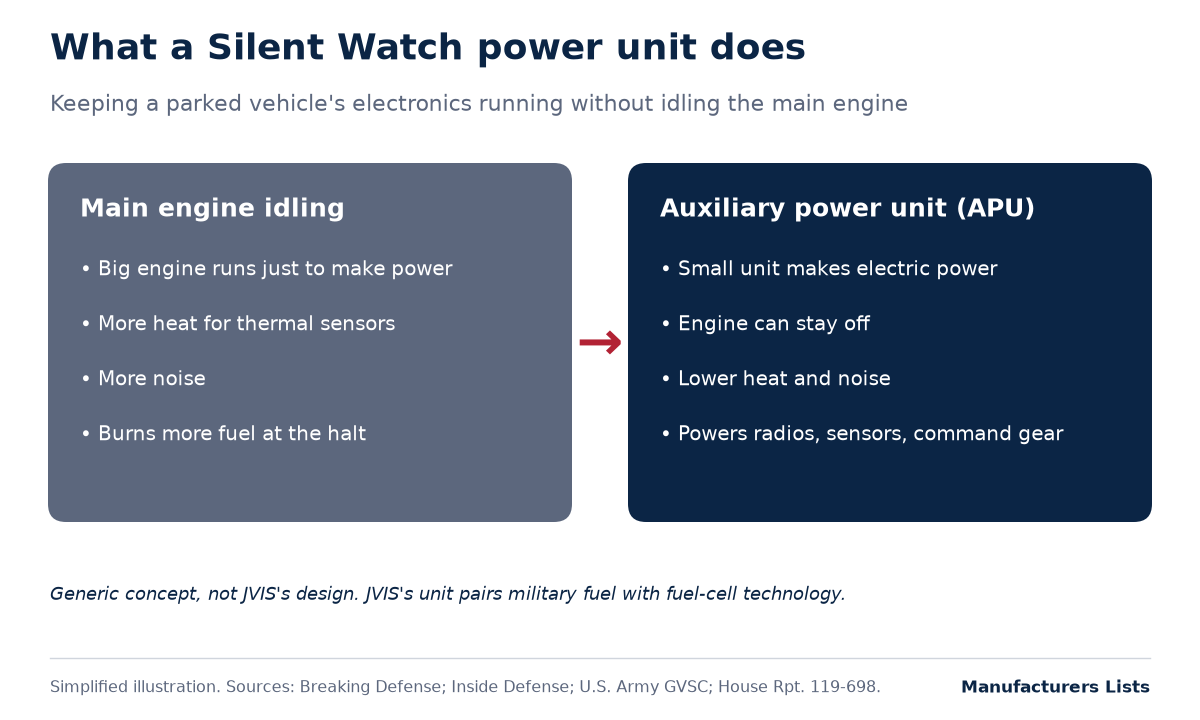
“Silent watch” is the military term for keeping a parked vehicle’s radios, sensors and other electronics running with the main engine off. Idling a large combat-vehicle engine just to make electricity burns fuel and gives off heat and noise, and those signatures make troops easier for an adversary to find.
An auxiliary power unit is a smaller power source that takes over that job. JVIS’s unit converts diesel into electric power so military systems don’t have to rely only on diesel generators, Breaking Defense reported. Inside Defense, citing the release, said the design pairs regular military fuel with fuel-cell technology to deliver “quiet, safe, efficient, low-signature power that enhances survivability and mission effectiveness.”
The Army has been asking for this kind of power. In August, Army leaders told a Detroit audience that soldiers lack enough power to efficiently charge drones, communications systems and command posts, Breaking Defense reported. The House Armed Services Committee’s report on the fiscal 2027 defense bill says the committee “recognizes the need to provide auxiliary power capabilities for the Ground Combat Vehicle fleet” to support “silent watch” and other electrical loads. The report also says the committee is concerned the Army “lacks a clear home for this requirement,” and it directs the Army to brief lawmakers by Dec. 1, 2026, on who will own vehicle-mounted auxiliary power and how it will move to production.
Warren’s Role
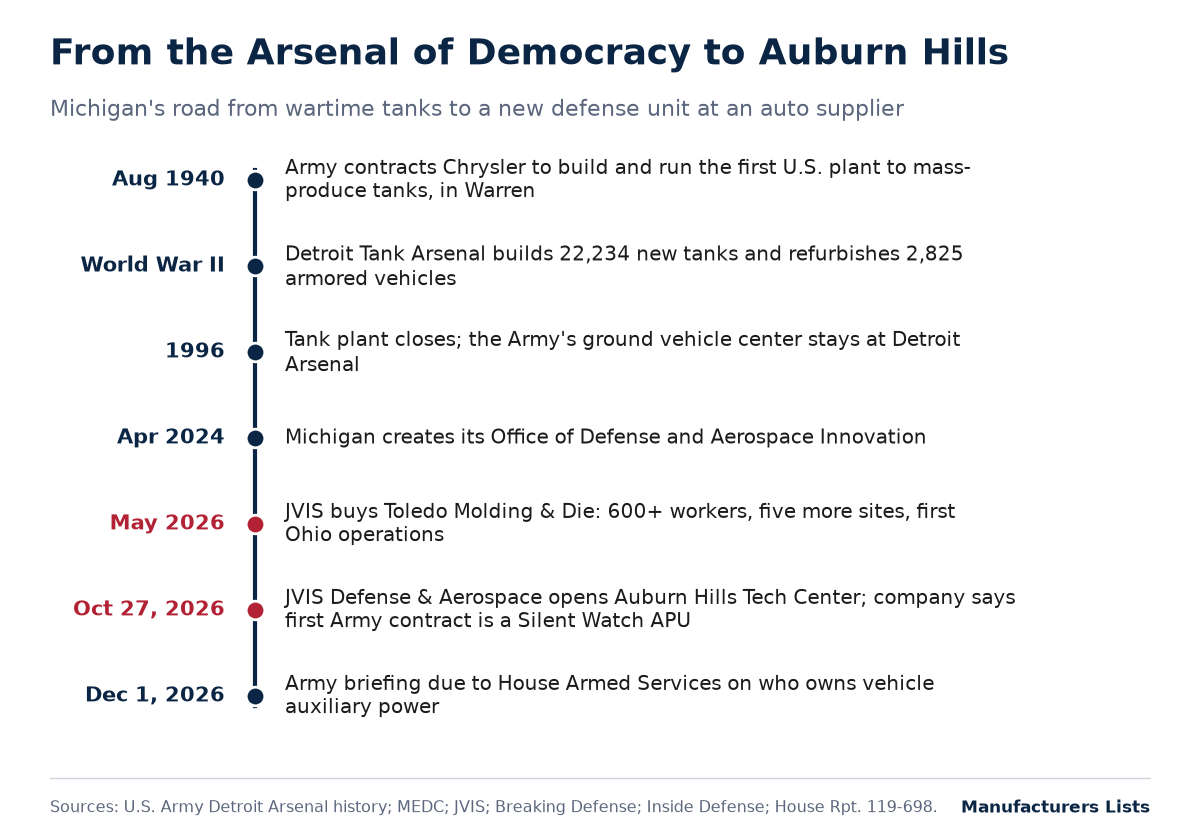
The Ground Vehicle Systems Center sits at the Detroit Arsenal in Warren, on the same ground where the country first mass-produced tanks. In August 1940, the Army awarded Chrysler the contract to build and operate that plant, and the first tank rolled out a little more than eight months later. During World War II, the arsenal built 22,234 new tanks and refurbished 2,825 armored vehicles, according to the Army. Tank production there ended when the plant closed in 1996.
Today the center’s labs test Army ground-vehicle power systems, including generators, auxiliary power units, fuel cells and hybrid electric systems, according to GVSC. That puts the Army’s ground-vehicle engineers within driving distance of hundreds of auto suppliers that already build parts in volume.
Michigan’s Auto-to-Defense Shift
JVIS is the latest in a string of Michigan auto and engineering companies chasing defense work. Breaking Defense noted that Michigan automakers, engineering firms and startups have pursued new military contracts for ground vehicles and robots in recent months, and one startup is developing munitions components. The state is courting that work through its Office of Defense and Aerospace Innovation, set up in April 2024 inside the Michigan Economic Development Corporation, and a five-year defense and aerospace strategic plan. The plan, signed by Gov. Gretchen Whitmer, aims to win military work beyond ground vehicles, including drones and space manufacturing, Breaking Defense reported.
Officials from both parties showed up for the opening. House Republican Conference Chairwoman Lisa McClain of Michigan said “Michigan has the manufacturing expertise and hardworking people our military needs,” in a statement. Democratic Sen. Gary Peters told the crowd the Tech Center would help create “good-paying Michigan jobs,” Breaking Defense reported.
The fit is practical. A combat vehicle is still a vehicle, and the skills that put a car into production carry over: tight tolerances, wiring, molded parts, testing and validation, and assembly lines that run at volume. For the Army, a supplier base that already builds parts at volume for carmakers is a source of capacity close to home.
What to Watch
- The jobs. The 1,000-plus figure is a company expectation with no stated timeline. Watch for hiring and any state incentive agreement, which would put the numbers in writing.
- Production sites. Murar said more manufacturing announcements will come “in the coming months and over the next year.” JVIS has not said where.
- The Army’s APU plan. The House committee’s Dec. 1 briefing deadline could show whether vehicle-mounted auxiliary power gets a program office and a path to production at scale.
- The contract. The $13.2 million figure comes from a company spokesperson. Watch for an Army announcement with terms.
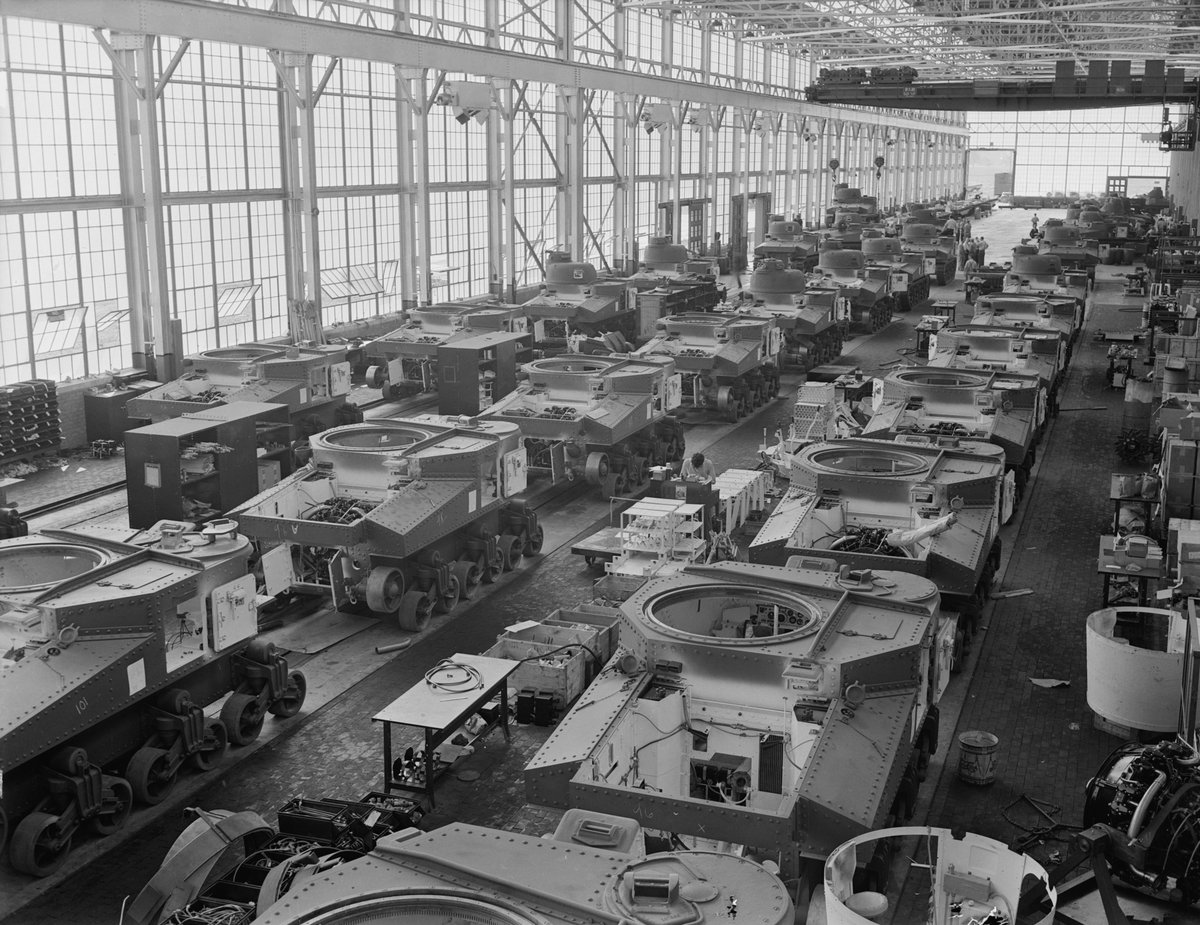
Top image: Partially completed M3 tanks on the assembly lines of the Chrysler tank arsenal, about 1940 to 1942. Photo: Alfred T. Palmer, Office of War Information, Library of Congress (fsa.8b00695) via Wikimedia Commons; public domain; cropped
Comments